
Making excellent pour-over coffee requires understanding extraction, not just owning the right gadgets. Many beginners get hung up on a gooseneck kettle, convinced it’s the entry ticket to clarity and complexity. It’s not. The fundamentals — the bloom, a consistent pour rate, and a precise total brew time — are what separate a flat cup from an exceptional one, and you can master them with surprisingly basic equipment.
The Bloom: An Essential First Step
The bloom is non-negotiable. It’s the initial wetting of your coffee grounds, allowing trapped carbon dioxide to escape. Freshly roasted coffee contains significant CO2, a byproduct of the roasting process. If you skip the bloom, this gas will repel water during the main pour, leading to uneven extraction, channels in your coffee bed, and ultimately, a sour, underdeveloped cup.
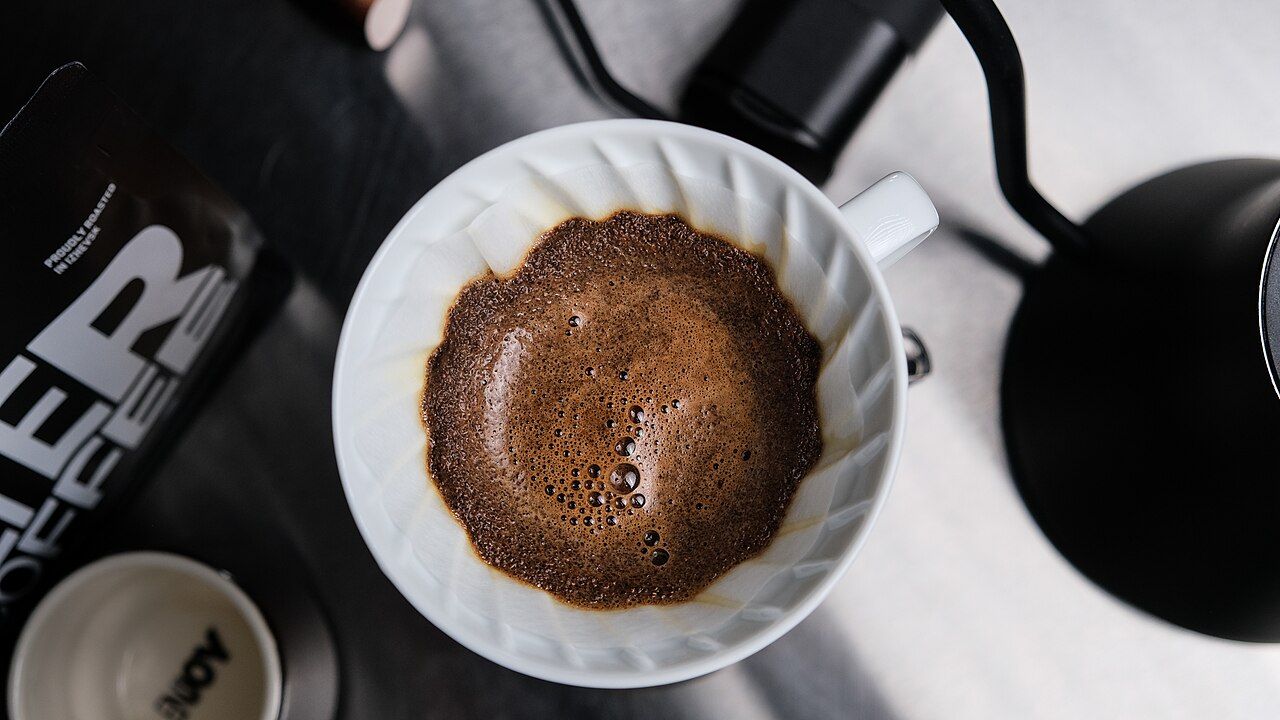
To bloom correctly, use water just off the boil, ideally between 200-205°F (93-96°C). Pour approximately twice the weight of your dry coffee in water, wetting all the grounds thoroughly. For 20 grams of coffee, use 40 grams of water. Start your timer when the water hits the grounds. Let it sit for 30-45 seconds. You’ll see the grounds expand and bubble; this is the CO2 escaping. This step ensures every particle is evenly saturated before the main extraction begins.
Controlled Pours, Consistent Extraction
After the bloom, the main pour dictates the consistency of your extraction. The goal is to maintain an even saturation of the coffee bed without disturbing it too aggressively. A consistent pour rate prevents channeling, where water finds easy paths through the coffee, leaving some grounds underextracted.
Even without a gooseneck, you can achieve a controlled pour. Use a standard kettle with a well-defined spout. Hold the kettle low to the dripper, about 1-2 inches above the grounds. Pour in slow, concentric circles, starting from the center and spiraling outward, then back in. The key is a steady, gentle stream. Avoid pouring directly onto the filter paper or disturbing the coffee bed too much. Aim for a continuous pour that keeps the water level relatively consistent, never letting the coffee bed dry out completely between pours.
For a typical 1:15 coffee-to-water ratio (e.g., 20g coffee to 300g water), you might perform 2-3 additional pours after the bloom, allowing the water to drain slightly before adding more. This segmented approach helps maintain an even temperature and prevents the bed from becoming waterlogged.
Total Time and the Grind Size Connection
Your total brew time is a critical indicator of extraction. It’s the cumulative time from the moment you start the bloom until the last drip falls. For a pour-over using a Hario V60 or Kalita Wave with 20-25 grams of coffee, a good target total brew time is typically 3 to 4 minutes. A Chemex, with its thicker filter and larger capacity, might extend to 4 to 5 minutes for a larger brew.
Grind size is the primary lever for adjusting total brew time. If your brew finishes too quickly (under 3 minutes) and tastes sour or thin, your grind is likely too coarse. Grind finer. If it finishes too slowly (over 4.5 minutes) and tastes bitter, astringent, or muddy, your grind is too fine. Grind coarser. This iterative process of tasting and adjusting your grind size is how you dial in your pour-over.
The Gooseneck: A Tool, Not a Requirement
Let's be clear: a gooseneck kettle provides unparalleled precision for controlling your pour rate and ensuring a gentle, even stream. Its narrow spout and ergonomic handle allow for extremely fine adjustments to water flow and targeting specific areas of the coffee bed. For advanced brewers seeking ultimate consistency, it's a valuable tool.
However, it is not an initiation ritual. Many home brewers produce incredible pour-over using standard kitchen kettles. Focus on the fundamentals first: buy a quality burr grinder, invest in an accurate digital scale, and learn to time your brews. These three items will have a far greater impact on your pour-over quality than any specialized kettle. Once you understand the mechanics of extraction and can consistently hit your target brew times with a basic kettle, then consider upgrading. Until then, learn to pour with intent. The best pour-over comes from disciplined technique, not just expensive hardware.
